The IAI was initiated as a result of a forum on Antarctic Affairs in 2003. Both the Tasmanian Governor at the time, Sir Guy Green, the Vice Chancellor of the University of Tasmania, Professor Daryl Le Grew, and the Director of IASOS, Professor McMinn saw an opportunity and envisioned the establishment of an International Antarctic University.
Invitations to attend a workshop to discuss the development of such an educational structure were extended to universities and relevant institutions throughout the world that were directly concerned with Antarctic undergraduate and postgraduate education. The workshop was held in Hobart in November 2004 and the concept received unanimous support from the 30 participants from 19 institutions representing 12 countries. Participants recognized a range of practical issues related to establishing and implementing such an Institute, including its funding and infrastructure needs and support.
During the meeting, the following resolutions were discussed and passed unanimously:
1. An international Antarctic institute (“the Institute”) should be established.
2. The Institute:
a. Shall comprise a consortium of participating institutions
b. Shall be governed by a council comprising a person appointed by each Participating Institution.
3. It is envisaged that the Institute will be multi-campus and multi-disciplinary and will:
a. Develop undergraduate and/or postgraduate courses and associated activities and provide joint supervision of student projects;
b. Be a vehicle to draw upon the strengths of each Participating Institution;
c. Facilitate student and faculty exchange.
4. The offer by the University of Tasmania to establish and resource an interim Secretariat to provide administrative support for the establishment of the Institute is accepted.
5. The offer by the University of Tasmania to establish and resource a Secretariat for the operation of the Institute for an initial period following its establishment is accepted.
6. As soon as practicable, each participating Institution shall provide the interim Secretariat with the name and contact details of a representative.
7. Following consultation with the Participating Institutions, the interim Secretariat shall generate detailed proposals and business plans for the structure and operation of the Institute for consideration and ratification by the appropriate institutional bodies.
That the interim Secretariat be authorized to inform the International Polar Year (IPY) Committee of the proposal to establish an international Antarctic institute and to register a Statement of Intent in anticipation of the establishment of the Institute.
Since the initial meeting a Constitution has been written and approved by all Members and individualized Memorandum of Understanding have been signed.
(By Andrew McMinn)
The IAI was formally voted into existence at the forum on Antarctic Education held in Hobart in 2004. The same meeting accepted the nomination of the University of Tasmania (UTAS) to host the IAI Secretariat from 2004. Dr Patti Virtue was engaged to coordinate the IAI secretariat and a part time secretarial assistant and a web development officer were employed to assist the Director (Prof Andrew McMinn) in the daily running of the institute. The first IAI Council Meeting was held in Hobart in 2006.
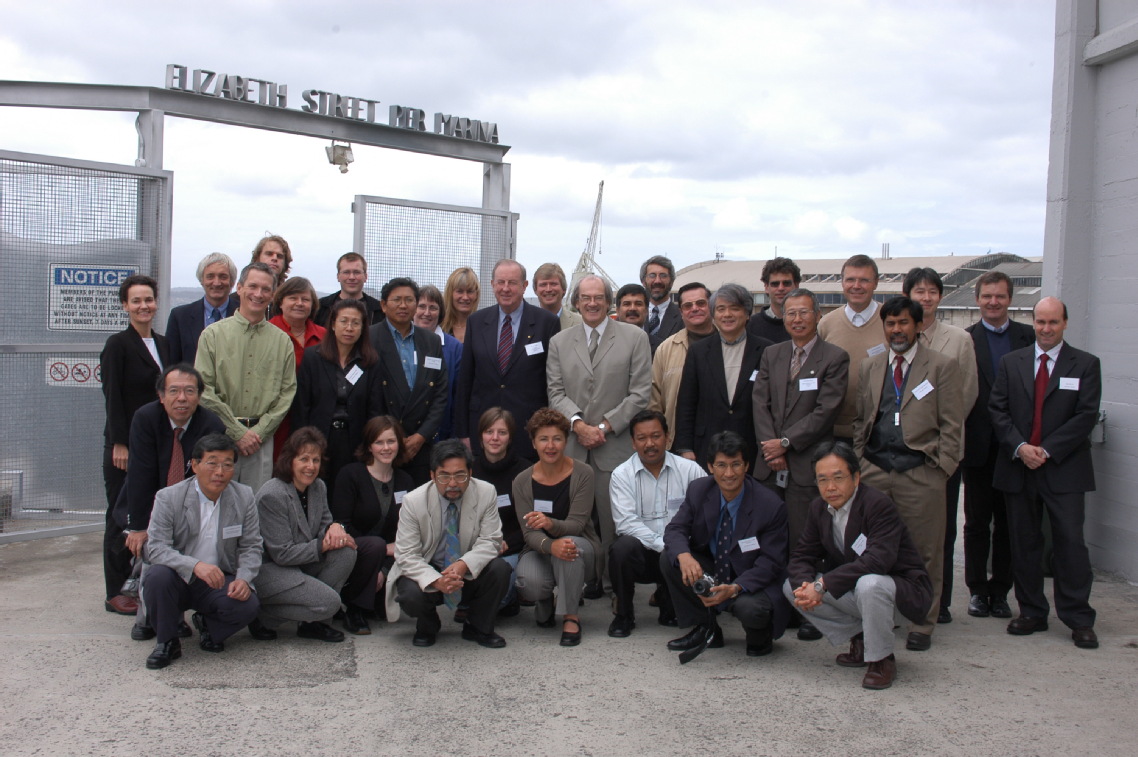
IAI planning meeting in Hobart in 2004
The primary tasks of the IAI secretariat were to develop and promote new courses, scope existing courses among member institutes, organise and run the biannual Council meetings, seek sponsorship, meet with each member institute.
IAI Council meetings were run in conjunction with the Scientific Committee on Antarctic Research (SCAR) Open Science meetings. These were held in Hobart (2006), St Petersburg (2008), Buenos Aires (2010), Portland (2012) and Auckland (2014). Sessions on Antarctic education were convened and run as part of these meetings.
Once the MOU and constitution had been finalised, the Director, together with then UTAS Vice Chancellor (President) Prof Daryl LeGrew, visited all member and aspirant institutions to encourage and finalise their membership. During this time University of Barcelona, University of Tromso, University of Sienna, Shanghai Ocean University and Ocean University of China successfully applied for membership.
During this time appropriate existing courses of most member institutions were assessed and approved by the Academic Coordinating Committee. New IAI field courses were developed and run by Hokkaido University and Hamilton College (USA). New courses including a dedicated masters program developed by UTAS, were also approved by the IAI Council.
The IAI also promoted cooperation in postgraduate research projects. National Antarctic research agencies were approached for support in giving students access to Antarctic and Southern Ocean field work and this resulted in students participating in research on RV Umitaka Maru (Japan). L’Astrolabe (France), RV Aurora Australia (Australia) and an Antarctic tourism company, Aurora Expeditions.
Given the high costs associated with transferring large numbers of students between institutions, we initiated the development of a visiting teacher scheme. This approach is significantly more efficient, as it involves relocating a single teacher rather than multiple students. Each participating teacher would deliver the same course across three institutions, with at least one located in a developing country. We continue to see considerable potential for further expansion and enhancement of this program. After holding the IAI Secretariat for ten years, UTAS sought offers from other members to take over the role. The Secretariat was handed over to Canterbury University (NZ) in 2015.
The original vision for the IAI was to unite universities engaged in polar teaching and research, giving students access to expertise beyond their home institutions. Initially intended to bridge specific knowledge gaps, the long-term goal was to offer joint degree programmes across multiple institutions focused on addressing global challenges.
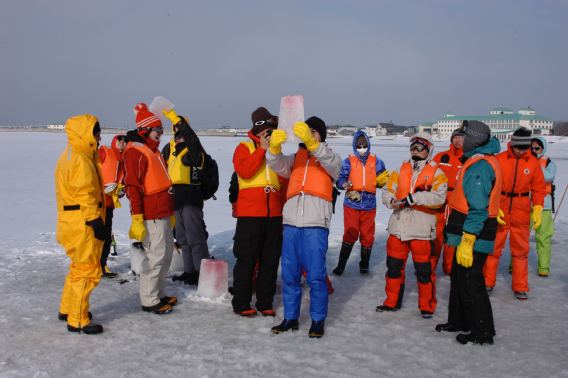
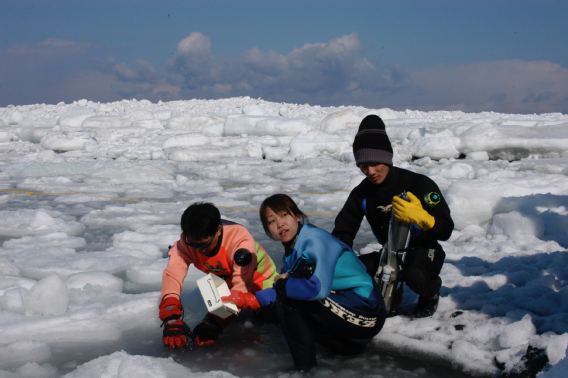
IAI sea ice field course in Hokkaido (2007)
(By Daniela Liggett)
After being hosted at the University of Tasmania since its founding in 2006, the IAI secretariat was transferred to Gateway Antarctica, the Centre for Antarctic Studies and Research at the University of Canterbury, New Zealand, in 2015. Professor Bryan Storey, who was at the time also the Director of Gateway Antarctica, took over the role of IAI Director from Professor Andrew McMinn.
With the transfer of the institutional seat of the IAI to Gateway Antarctica and the University of Canterbury, the IAI website was also relocated to the University of Canterbury. At the same time, plans were under development for an IAI field course based at Gondwana Station in Terra Nova Bay. Logistics support for this field course had been obtained from the Italian and German National Antarctic Programmes. Unfortunately, although three students had enrolled for this course, the inaugural expedition had to be cancelled in 2017 because medical support and search and rescue assistance could not be provided by Antarctica New Zealand.
At the end of 2018, Professor Storey retired as Director of Gateway Antarctica, and the IAI directorship was passed to Professor Wolfgang Rack, a senior glaciologist affiliated with Gateway Antarctica. Professor Rack would later on also because the Director of Gateway Antarctica.
As prior to 2014, the IAI secretariat continued to coordinate IAI‑labelled courses and issue IAI endorsement letters for students from member institutions. As over the first eight years of its existence, in-person meetings were held in conjunction with major Antarctic conferences, foremost the Scientific Committee on Antarctic Research’s Biennial Open Science Conferences, to ensure that personal connections between key representatives at IAI member institutions would remain strong. Existing postgraduate programmes such as the Master of Antarctic Studies and the Postgraduate Certificate in Antarctic Studies at the University of Canterbury, and postgraduate programmes of study at partner universities, continued to symbolise the IAI’s educational remit and reach but IAI activities were seriously curtailed by the travel restrictions imposed by the COVID‑19 pandemic. The latter resulted in the cancellation of most mobility programmes and many field‑based activities, which reflected wider disruptions across the polar research and education sector.
During the COVID-19 lockdowns, online discussions were held between IAI colleagues at the University of Canterbury and the University of Tasmania about returning the IAI secretariat to the University of Tasmania. This transition was prompted by capacity and funding shortages at the University of Canterbury after institutional restructuring and was completed in 2022, marking a renewed Australian role in coordinating the network.
In 2024, Professor Jiuxin Shi at the Ocean University of China signalled the willingness of Ocean University to play a more active role in shaping the future of the IAI by hosting and funding the IAI secretariat, reflecting the growing engagement of Asian partners in relation to cryosphere education initiatives. The IAI member institutions accepted this offer from Ocean University, and the IAI secretariat formally moved to the Ocean University of China, with Professor Shi as its new Director, in late 2025.
Today the IAI continues as a multi‑national, multi‑institutional consortium with a twenty‑year track record of cross‑accredited courses, student mobility and field opportunities, and is positioning itself to contribute to the education and outreach legacy of the 5th International Polar Year.
Address: No. 238 Songling Road, Qingdao 266100, P. R. China
Tel: +86-532-66782730
Email: iai@ouc.edu.cn
© International Antarctic Institute